
June Allyson and Dick Powell (they stayed married since 19 August 1945 until his death 2 January 1963)

Humphrey Bogart kissing actress June Allyson, Dick Powell's wife
Humphrey Bogart -who bought the "Santana" sailboat from fellow actor Dick Powell (who had to abandon his love of sailing due to his sinus problems) in 1945 soon after marrying the young and strikingly beautiful Lauren Bacall- turned his yatch into his personal sanctuary. Aside from escape, Bogart also sought competition. Commemorative plaques in the galley, earned in the 1950 and 1951 San Clemente Island races and the 1953 Voyagers Yacht Club Channel Islands Race, prove that Bogart knew how to win navigating the sea too.

Humphrey Bogart as Philip Marlowe in "The Big Sleep" (1946) directed by Howard Hawks

Dick Powell as Philip Marlowe in "Murder, My Sweet" (1944) directed by Edward Dmytryk
"Dick Powell is even dryer in the part than Bogart, erasing entirely the crooner's geniality that had made him a popular fixture in Warner musicals. The only echo of the earlier Powell is the actor physical's grace -he has a dancer flowing ease. Powell's voice is flat, his face taut and frozen in the masklike noir vein, and he plays Marlowe as a blunt, no-nonsense professional. His work is wonderfully tight and economical; he is guarded and sardonic, but he falls a bit short of projecting Bogart's aura of absolute integrity." -"The Dark Side of the Screen: Film Noir" (2008) by Foster Hirsch

Dick Powell and Lucille Ball in "Meet the People" (1944) directed by Charles Reisner
"As Alain Silver points out in his commentary, Powell's casting was dramatically against type, so much so that they had to change the name of the picture so people wouldn't confuse it with a musical. Singing marine to hard boiled detective is quite a leap, and many people simply can't get past their strong association of Powell with musicals."

Mike Mazurki and Dick Powell in "Murder, My Sweet" (1944)
"Powell is often mentioned as Chandler's favorite incarnation of Marlowe, praise that is rightfully earned. Powell's Marlowe is both jaded and optimistic, world-weary yet open to life. He delivers certain lines with cutting self-deprecation, others with calculated softness. His Marlowe is always pushing buttons, probing people for weakness, wresting control of the situation. Though he isn't physically imposing (something about his face is too gentle to completely intimidate) his confident delivery and compromised sense of values sell his dangerous side."

"Powell's subtlety sufficiently sells the character. At one point, femme fatale Helen "confesses" to Marlowe about her role in the caper. Her face is buried in his shoulder and her features are in shadow. Though she is speaking, Marlowe is in the spotlight. His flashes of annoyance and the slight roll of his eyes say that he isn't buying a word of it. Nonetheless, he falls easily enough into her arms, for amusement or to keep up appearances. Helen Grayle may be one of the weakest femme fatales on record, because she never fully ensnares Marlowe. It is Powell's incorrigible surety that prevents Marlowe from being fully swallowed into the depths of this noir."

"Powell is solid, but the cinematography makes him all the better. Dmytryk and veteran cinematographer Harry J. Wild create a brooding environment where shadow threatens to overwhelm the characters. In the commentary, Silver reminds us that Wild and other crew members were RKO regulars who created the stunning visuals for Citizen Kane. Here we see the same deep focus, the same dramatic shading and composition. Dmytryk even throws in a drug trip which is oddly convincing. In terms of pure cinematography, 'Murder, My Sweet' is unmistakably noir, superbly handled noir at that. My favorite scene in that regard is one of the earliest, when Marlowe is "relaxing" in his office under the repetitive glare of a flashing neon sign."

"The music fits equally well. Composer Roy Webb has an absolutely staggering body of work: he had a career's worth both before and after 'Murder, My Sweet' (including Out of the Past, another film in this boxed set). Much of his work inhabits the shadows of film noir. Webb produces tension in the opening interrogation scene by repeating a toneless bass riff with tinkling counterpoints. It has been done time and again, but it works. Recent soundtracks I've heard that use the same trick somehow lack Webb's panache. Other moments of music truly set the tone, putting us on edge almost imperceptibly."
Source: www.dvdverdict.com
Humphrey Bogart in "Dark Passage" (1947) directed by Delmer Davis
In Dark Passage, Vincent Parry (Humphrey Bogart) escapes from San Quentin, hoping to clear his name for the murder of his estranged wife. He's aided first by a sympathetic socialite (Lauren Bacall), then by a plastic surgeon who alters Parry's face to make him unrecognizable.

Unlike Lady in the Lake, Dark Passage uses subjective camerawork only for its first 45 minutes or so; after Parry's bandages come off, Bogart steps in front of the camera (he'd supplied a voice over until that point) and the film proceeds from an "objective" point of view. But for a handful of linking scenes in which Montgomery (as Marlowe) recounts bits of the story from his office, Lady in the Lake is shot exclusively in the first person.

Robert Montgomery as Philip Marlowe in "Lady in the Lake" (1947)
Robert Montgomery had originally wanted to use the subjective camera technique to film John Galsworthy's novel Escape, but was persuaded by the studio to take on a more contemporary, and bankable, adaptation. Ironically, the second first-person film of 1947 -- Delmer Daves' Dark Passage, adapted from the thriller by David Goodis -- bears close similarities to Galsworthy's work, which follows a convict's flight after he breaks out of prison.

Lauren Bacall as Irene Jansen in "Dark Passage" (1947)
But in the time that we share Parry's point of view, we fall off a truck and roll down a hill, climb a fence and hitch a ride, engage in fisticuffs with a nosy driver, snoop around Bacall's boudoir, and hallucinate under the effects of anesthesia.

Robert Montgomery as Philip Marlowe and Audrey Totter as Adrienne Fromsett in "Lady in the Lake" (1947) directed by Robert Montgomery
From a technical standpoint, Lady in the Lake is more ambitious, but Dark Passage is more polished. The latter also benefits from extensive location shooting in and around San Francisco, and a more motivated use of its subjective camera. Still, the limited range of movement available to the bulky cameras of the day makes both films seem rather slow and stiff. What is it about noir that seems to lend itself to the use of the subjective camera?
Source: www.bighousefilm.com
“‘I always find what I want. But when I find it, I don’t want it any more.” —Raymond Chandler
Raymond Chandler wrote in a letter to Charles Morton that: “It doesn’t matter a damn what a novel is about.” He goes on to say that “the only fiction of any moment in any age is that which does magic with words.” In a letter to Mrs. Robert Hogan, Chandler stressed that “the most durable thing in writing is style, and style is the most valuable investment a writer can make with his time.”

The story of how the script of "Lady in the Lake" ended up being written is another odd chapter in Chandler’s life in Hollywood. Chandler took the job of adapting his novel to the screen, or so the story goes, to protect his work from “studio hacks.” But in a few weeks, he began to lose interest. “[Working on the screenplay] bores me stiff. Just turning over dry bones,” he wrote in a letter to James Sandoe. After 12 weeks Chandler left the project leaving behind an unfinished script that was given to a studio writer to salvage. He was opposed to the use of the subjective camera saying, “it’ll never work.”
Clips from the films "Murder, My Sweet" starring Dick Powell, Claire Trevor & Anne Shirley, "The Big Sleep" starring Humphrey Bogart, Lauren Bacall & Martha Vickers, and "Lady in the Lake" starring Robert Montgomery, Audrey Totter & Lila Leeds.

 New publicity stills of Michael Peña and Jake Gyllenhaal in "End of Watch" (2012) directed by David Ayer

 Jake Gyllenhaal enjoys an ice cream with "An Enemy" co-star Sarah Gadon in Toronto, on July 6, 2012
 Dana Andrews and Linda Darnell in "Fallen Angel" (1945) directed by Otto Preminger
 Kirk Douglas and Barbara Stanwyck in "The Strange Love of Martha Ivers" (1946) directed by Lewis Milestone
 Jane Greer and Robert Mitchum in "Out of the Past" (1947) directed by Jacques Tourneur
 Gloria Grahame and Sterling Hayden in a still for ‘Naked Alibi’ (1954) directed by Jerry Hopper
 June Allyson and Dick Powell (they stayed married since 19 August 1945 until his death 2 January 1963)
 Humphrey Bogart kissing actress June Allyson, Dick Powell's wife
 Humphrey Bogart as Philip Marlowe in "The Big Sleep" (1946) directed by Howard Hawks
 Dick Powell as Philip Marlowe in "Murder, My Sweet" (1944) directed by Edward Dmytryk
 Dick Powell and Lucille Ball in "Meet the People" (1944) directed by Charles Reisner
 Mike Mazurki and Dick Powell in "Murder, My Sweet" (1944)
 "Powell's subtlety sufficiently sells the character. At one point, femme fatale Helen "confesses" to Marlowe about her role in the caper. Her face is buried in his shoulder and her features are in shadow. Though she is speaking, Marlowe is in the spotlight. His flashes of annoyance and the slight roll of his eyes say that he isn't buying a word of it. Nonetheless, he falls easily enough into her arms, for amusement or to keep up appearances. Helen Grayle may be one of the weakest femme fatales on record, because she never fully ensnares Marlowe. It is Powell's incorrigible surety that prevents Marlowe from being fully swallowed into the depths of this noir."
 "Powell is solid, but the cinematography makes him all the better. Dmytryk and veteran cinematographer Harry J. Wild create a brooding environment where shadow threatens to overwhelm the characters. In the commentary, Silver reminds us that Wild and other crew members were RKO regulars who created the stunning visuals for Citizen Kane. Here we see the same deep focus, the same dramatic shading and composition. Dmytryk even throws in a drug trip which is oddly convincing. In terms of pure cinematography, 'Murder, My Sweet' is unmistakably noir, superbly handled noir at that. My favorite scene in that regard is one of the earliest, when Marlowe is "relaxing" in his office under the repetitive glare of a flashing neon sign."
 "The music fits equally well. Composer Roy Webb has an absolutely staggering body of work: he had a career's worth both before and after 'Murder, My Sweet' (including Out of the Past, another film in this boxed set). Much of his work inhabits the shadows of film noir. Webb produces tension in the opening interrogation scene by repeating a toneless bass riff with tinkling counterpoints. It has been done time and again, but it works. Recent soundtracks I've heard that use the same trick somehow lack Webb's panache. Other moments of music truly set the tone, putting us on edge almost imperceptibly." Source: www.dvdverdict.com
 Humphrey Bogart in "Dark Passage" (1947) directed by Delmer Davis
 Unlike Lady in the Lake, Dark Passage uses subjective camerawork only for its first 45 minutes or so; after Parry's bandages come off, Bogart steps in front of the camera (he'd supplied a voice over until that point) and the film proceeds from an "objective" point of view. But for a handful of linking scenes in which Montgomery (as Marlowe) recounts bits of the story from his office, Lady in the Lake is shot exclusively in the first person.
 Robert Montgomery as Philip Marlowe in "Lady in the Lake" (1947)
 Lauren Bacall as Irene Jansen in "Dark Passage" (1947)
 Robert Montgomery as Philip Marlowe and Audrey Totter as Adrienne Fromsett in "Lady in the Lake" (1947) directed by Robert Montgomery
 “‘I always find what I want. But when I find it, I don’t want it any more.” —Raymond Chandler
 The story of how the script of "Lady in the Lake" ended up being written is another odd chapter in Chandler’s life in Hollywood. Chandler took the job of adapting his novel to the screen, or so the story goes, to protect his work from “studio hacks.” But in a few weeks, he began to lose interest. “[Working on the screenplay] bores me stiff. Just turning over dry bones,” he wrote in a letter to James Sandoe. After 12 weeks Chandler left the project leaving behind an unfinished script that was given to a studio writer to salvage. He was opposed to the use of the subjective camera saying, “it’ll never work.”
 Carole Landis as Vicky Lynn in "I Wake Up Screaming" (1941) directed by H. Bruce Humberstone
 "In the penumbral world of the detective story, based on the virile and existentially skeptical work of writers like Hammett, Chandler, Cain, and David Goodis (which found its way into crime films like Dark Passage, The Blue Dahlia, Farewell My Lovely, Double Indemnity, I Wake Up Screaming, and The Big Sleep), the proliferation of women —broads, dames, and ladies in as many shapes and flavors, hard and soft centers as a Whitman’s sampler was a way of not having to concentrate on a single woman, and again, of reducing woman’s stature by siphoning her qualities off into separate women." -"From Reverence to Rape: The Treatment of Women in the Movies" (1974) by Molly Haskell
 Humphrey Bogart
 Sterling Hayden
 Dana Andrews
 Dick Powell
 Burt Lancaster
 Alan Ladd
 Ella Raines in "Phantom Lady" (1944) directed by Robert Siodmak
 Looking to escape Paris for the United States, Siodmak would claim to have been born in Memphis and subsequently taken by his parents to Germany. The New York Times, which profiled the director at the height of his success, called him “the only native-born American with a foreign accent in Hollywood.”
  The killer in “Phantom Lady” (1944) is a megalomaniacal artist who links himself with the great criminals of history. Produced by the Hitchcock assistant Joan Harrison, “Phantom Lady” associated Siodmak with one of Hollywood’s leading filmmakers. “Something was bound to happen when a former Alfred Hitchcock protégée and a former director of German horror films were teamed on the Universal lot,” Bosley Crowther wrote in The New York Times, “something severe and unrelenting, drenched in creeping morbidity and gloom.”
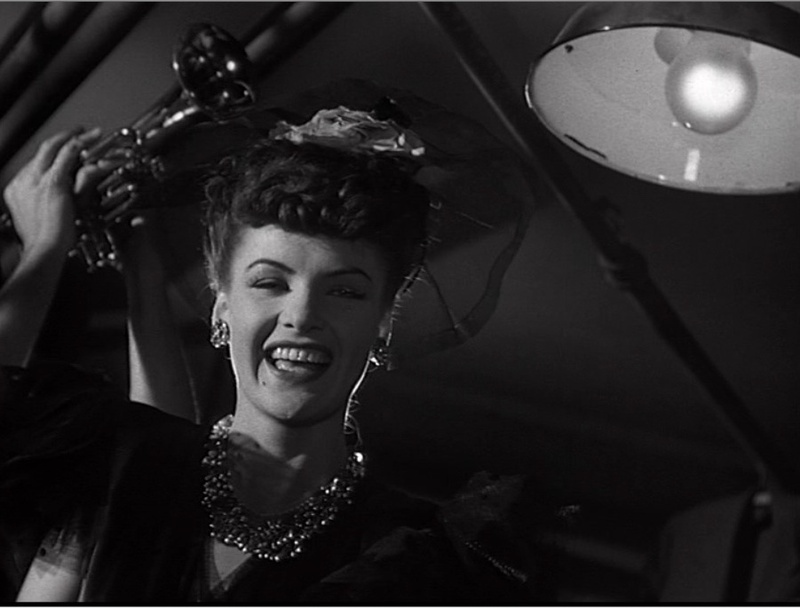 And it did happen: “Phantom Lady,” in which spunky Ella Raines assigns herself to save a man framed for the murder of his wife, has a nightmarish quality and dreamlike flow that transcends the banality of its script. The movie’s chiaroscuro soundstage Manhattan often resembles the demonic Berlin of a Weimar silent film, but Siodmak was also alert to the possibilities of musical montage, most emphatically in the feverishly erotic jam session Raines attends in an after-hours jazz club.
 “Christmas Holiday” (1944) — in which Siodmak was tasked with providing Universal’s stellar ingénue, Deanna Durbin, an adult role, namely a chanteuse in a New Orleans bordello — is a noir as odd as its title. It’s an intricately lighted gothic romance that casts Gene Kelly as a neurotic tough guy and makes near-surreal use of Wagner’s “Liebestod.”
  Then Siodmak was on loan to RKO for the lurid thriller “The Spiral Staircase” (1946). A week after this hit shocker opened, The New York Times reported that Siodmak was “disturbed by the many recently published references to him as ‘a second Alfred Hitchcock.’ ” His next Universal film, “The Dark Mirror” (1946), a doppelgänger mystery starring a twinned Olivia de Havilland, only reinforced that idea of Siodmak as a director of clever psychological thrillers. But Siodmak’s third release of 1946 was something else.
 Burt Lancaster and Ava Gardner in "The Killers" (1946) directed by Robert Siodmak
 Siodmak received an Oscar nomination for directing “The Killers,” which also garnered nominations for screenplay, score and editing — “The Spiral Staircase” and “The Dark Mirror” got nominations as well — and contemporary reviews of “The Killers” rarely fail to cite the director’s touch. The connoisseurs James Agee and Manny Farber were both impressed. Agee praised Siodmak’s “journalistic feeling for tension, noise, sentiment and jazzed-up realism.” Farber credited Siodmak with the movie’s “stolid documentary style” and “gaudy melodramatic flavor” while noting “the artiness (most noticeable in the way scenes are sculpted in dark and light).”
 “Criss Cross” (1949), again starring Lancaster, now opposite Yvonne DeCarlo, includes several of the director’s great set pieces. The prolonged rumba in which the sultry DeCarlo dances with a pompadoured lounge lizard (an uncredited Tony Curtis, spotted by Siodmak among the extras) is as powerful as the jam session in “Phantom Lady”; an armored car heist pulled off in a miasma of tear gas appears as a battle of corpses; a hospital rub-out anticipates one of the most famous scenes in “The Godfather.”
 With its quasi-documentary use of Bunker Hill in Los Angeles and the flat expanse of the San Fernando Valley, as well as the novelist Daniel Fuchs’s slangy script, “Criss Cross” is Siodmak’s most American film. It also signaled a thwarted shift in his interests. The director made an unsuccessful movie with Hollywood’s resident naturalist, the producer Louis De Rochemont, and worked with Budd Schulberg on what would become “On the Waterfront.” (Dumped from the project, Siodmak successfully sued the producer Sam Spiegel for $100,000.)
 Severely re-edited for release in the United States, “Custer” appeared as the director’s final puzzlement. Reviewing it in The New York Times, Renata Adler saw signs that “somebody meant to try something fairly ambitious.” Custer appeared as “a thoroughly modern man who would have liked Camus” — an enigmatic fatalist, not unlike Siodmak. Source: www.nytimes.com
 "A gentleman is simply a patient wolf." -Lana Turner
 Lana Turner - MGM contract player
 "I've always loved a challenge." -Lana Turner
 Lana Turner serving up a cold treat


