WEIRDLAND

Ad Sense

Thursday, January 06, 2022

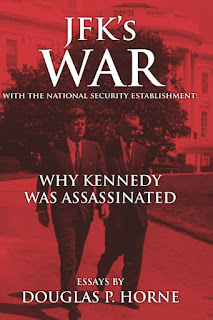
JFK's War: Essays by Douglas Horne, The Talented Matt Damon

Max Boot, a conservative who has long favored regime-change operations on the part of the U.S. national-security establishment, is going after Hollywood producer and director Oliver Stone. His beef with Stone? He’s upset because Stone has long maintained that the U.S. national-security establishment employed one of its patented regime-change operations here at home, against President John F. Kennedy. What does Boot say about Saundra Spencer in his piece for The Washington Post? Absolutely nothing. Spencer’s testimony matched what Dr. Robert McClelland, who was one of JFK’s treating physicians at Parkland Hospital, said. He stated that Kennedy had a massive exit-sized wound in the back of his head. McClelland wasn’t the only one who said that. So did the other treating physicians, nurses, a Secret Service agent, two FBI agents, and others. What does Boot say about Dr. McClelland and all those other witnesses who stated that JFK had a massive exit-sized wound in the back of his head? Absolutely nothing. What does a fraudulent autopsy have to do with the assassination? It tells us that the assassination was a regime-change operation, no different from other regime-change operations carried out by the national-security establishment, in places like Iran (1953), Guatemala (1954), Indonesia (1958), Congo (1961), Cuba (1960 to date), Chile (1970-73), and others. It is predictable that Boot would cherry pick the speeches, since he was and is a neocon. He was a former member of the calamitous Project for the New American Century, which advocated for American intervention in Iraq as far back as the Clinton administration. Boot championed intervention in Afghanistan and opposed withdrawal. He had no problem with Hillary Clinton’s unmitigated disaster in Libya. He also agreed with her advocacy of direct American intervention in Syria. There has scarcely been a war that Max Boot did not like—no matter how bad the results were. Source: www.counterpunch.org

Matt Damon was once cast to play Robert F. Kennedy in a biopic about the late politician. Deadline and Variety reported that the film would be based on the Evan Thomas biography RFK: His Life. Gary Ross (Seabiscuit) was chosen to direct from a screenplay by Steven Knight.  The biopic would have spanned Kennedy's ascent from his brother's shadow to a powerful nation figure before being assassinated during his 1968 campaign for President. This might have been finally Damon's shot at a long-deserved Oscar. Sadly, it didn't happen, but on paper, you had a respected, likeable and talented actor playing a larger-than-life American icon. While Damon was nominated for Best Supporting Actor for his portrayal of South African rugby star Francois Pienaar in Clint Eastwood's Invictus, that doesn't even begin to compare to playing Robert F. Kennedy. Damon is the goods and RFK's story is worth telling so it's really a missed opportunity the studios decided to pass on the project. Speaking to CNBC, Matt Damon said: "If they could figure out a way to do Bobby Kennedy, I would love to do that. I just love that guy, and the incredible things he was saying at the end of his life." Source: collider.com

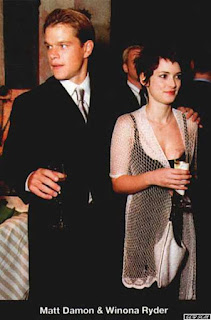
Following his split with Winona Ryder in the spring 2000, romance had continued to prove difficult for Matt Damon. Co-starring with Spanish actress Penelope Cruz in 2000’s All the Pretty Horses had inevitably, led to rumours that the pair had been romantically involved. ‘She’s a dear friend,’ said Matt, ‘but unfortunately we haven’t had any time to be together. She went off to make Captain Corelli’s Mandolin and since November I’ve been in Europe filming The Bourne Identity.’ Cruz went on to have a three-year relationship with Tom Cruise after she co-starred with him in Vanilla Sky (2001), before going on to marry fellow Spanish actor Javier Bardem in 2010. As it turned out, Matt didn’t have to look too far afield for his next relationship. He met Odessa Whitmire when she was working as Ben Affleck’s personal assistant. Whitmire, from North Carolina and five years Matt’s junior, had previously acted as professional assistant to actor-writer-director Billy Bob Thornton when he was dating Laura Dern in the mid-1990s. In 1999 Thornton had directed Matt in All The Pretty Horses, when Whitmire was still part of Thornton’s group of assistants. It was during the shoot on that picture that Matt first met Odessa, then in her mid-20s, although they wouldn’t properly hook up until 2001 when she was working for Ben Affleck. Learning from experience, Matt did his best to keep the relationship private - unlike Minnie Driver and Winona Ryder, Odessa wasn’t an actress or a public figure. 

They only appeared together in public at two events - both international premieres for his film The Bourne Identity in Taipei, Taiwan and in Sydney, Australia. Matt hoped that dating a ‘civilian’ might result in a longer lasting relationship than those he’d had with actresses. ‘If you’re with somebody who’s in the business, the attention becomes exponentially more severe,’ said Matt to Boston magazine. ‘I think if you don’t date anybody who’s in the movie business, you’re one step ahead. If you’re not going out to nightclubs and dancing, the paparazzi leave you alone, and once they leave you alone then you’re not in the magazines at all, and then the magazines leave you alone.’ Well, it was a theory - and for a couple of years the secrecy seemed to work. However, the press were not about to leave the star of The Bourne Identity alone, so rumours soon began that he and Odessa were preparing to get married - and that provoked a reaction. In December 2002, Damon’s publicist Jennifer Allen was issuing statements in response to a report of the couple’s impending nuptials in a gossip column in the New York Post: ‘The rumour that he’s getting engaged has been fabricated over the past couple of weeks, but it’s not true. He is dating Ms. Whitmire, but he is not engaged.’ Even Matt’s father, Kent Damon, was forced to deny the marriage claims. Whether it was the public pressure, or Whitmore's possible past relationship with Affleck, the relationship was over by the following Halloween. Whitmire moved on from Damon, opening a chain of vintage clothing stores called Some Odd Rubies with outlets in New York and Los Angeles, but she also continued to work as Affleck’s occasional assistant at least up to Argo in 2012. The break-up with Whitmire meant it was open season on Matt Damon once again, allowing the press to speculate about who he was dating, often with little evidence but a lot of imagination. As he’d dated at least two co-stars previously, surely he couldn’t have failed to hook up with Eva Mendes, his Stuck on You (2002) co-star, right? It was actually during the making of Stuck on You that Matt would meet the woman who’d eventually become his wife and give him the opportunity to start a family, but it wasn’t Eva Mendes. 

It would be Luciana Bozán Barroso, an Argentinian interior decorator who worked as a barmaid in the Crobar at the Fontainebleau Hotel in Miami in 2002. Matt recalled: "I swear to God, that happened to me… something incredible happened the first time I saw her." Lucy was soon to accompany the star on his 2004 tour across Europe shooting on Ocean’s Twelve, before returning with him home to Boston to meet his family, where he then worked on making The Departed. By 2005, Matt announced his marriage to Lucy, proposing just before the Labour Day holiday. Matt was determined to keep his ‘private life’ as private as possible, especially as Lucy was not in show business. The marriage took place in December 2005 in a small, private ceremony held at the Manhattan Marriage Bureau. Accompanying the newly-weds was Lucy’s daughter Alexia from a previous relationship. Alexia soon had three sisters - Isabella (born 2006), Gia (b. 2008), and Stella (b. 2010) - making for a family of six. One person happy with the arrangements was Lucy’s ex-husband (they divorced in 2004) and father of Alexia, Arbello ‘Arby’ Barroso, with whom Matt developed a good relationship. ‘I couldn’t possibly have asked for a better stepfather for my daughter than Matt Damon,’ Arby told Star magazine. ‘He treats Alexia like she is his own flesh and blood. Matt has been an absolute blessing for my daughter. Matt is a fantastic stepfather and Luciana is a terrific mom.’ For his part, Matt adjusted to becoming an instant father with Alexia and to fathering his own three daughters over the next five years. ‘Suddenly it wasn’t just my wife,’ said Matt, ‘it was her four-year-old little girl… There was never a choice. It was just the way it was, and I was happy for that. I can’t imagine my life having not gone down that road. I can’t imagine what my life would be now. I don’t want to imagine it.’ Matt’s instincts were right: he would find a lasting and fulfilling relationship with someone from outside the film industry, after years of dating actresses and others associated with the business. That distance from his work was ultimately what he needed in order to make a success of romance. Source: The Talented Matt Damon (2016) by Brian J. Robb
 

Tuesday, January 04, 2022

Don't Look Up, The American Republic in Crisis

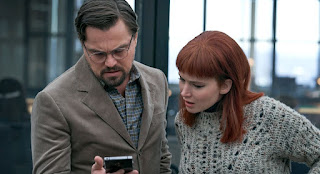
The scariest thing about Don’t Look Up is that as absurd as it is, it barely exaggerates. Much of our political elite are just as greedy and foolish, our media just as vapid, and our response to impending disaster exactly as mind-bogglingly irrational as in the movie. There’s no villainous authoritarian ending democracy; as in our world, American democracy in the film has already been smothered under the weight of oligarch money and corporate profit-chasing. There’s no secret evil conspiracy; the villains are just a self-obsessed, blinkered elite, and it’s their greed, venality, and stupidity that lead them to evil decisions. Astronomers Kate Dibiasky (Jennifer Lawrence) and Randall Mindy (Leonardo DiCaprio) are frustrated every step of the way in their efforts. It’s insane that people in power and influence would jeopardize stopping the literal apocalypse because they either saw it as a money-making opportunity or because they didn’t want to talk about bad news. The ending of Don't Look Up is great, with multiple references to the Suicide of the West, but unfortunately, it couldn't save the movie. Source: jacobinmag.com

Niall Ferguson: An increasing number of anxious American political commentators are asking themselves a version of this question: "Are we the baddies?". For some time, it has been a concern of political scientists such as my colleague Larry Diamond that the world is in a “democratic recession” or “regression,” which he dates from around 2006. Compared with the 1970s or 1980s, according to all the major surveys and databases, the world is a significantly more democratic place. Not only are there many more democracies (57% of all countries in 2017, compared with 25% in the mid-’70s); democracies also account for around three-quarters of global GDP. In 2013, the nonpartisan organization Freedom House gave the U.S. a score of 93 out of 100 in its annual Freedom in the World report. Today, that figure is down to 83, meaning that the U.S. now ranks below 60 other democracies, including Argentina and Romania. This is because (according to Freedom House) America’s “democratic institutions have suffered erosion, as reflected in partisan pressure on the electoral process, bias and dysfunction in the criminal justice system, harmful policies on immigration and asylum seekers, and growing disparities in wealth, economic opportunity and political influence.” Such self-criticism is music to the ears of this country’s strategic rivals. Earlier this month, the Chinese Ministry of Foreign Affairs had the audacity to publish an essay-length critique of American democracy. It is, the authors argued, “a system fraught with deep-seated problems”—a “game of money politics” in which the theory of “one person one vote” is belied by the reality of “rule of the minority elite.” “Democracy in the US,” the authors state, “has become alienated and degenerated. Problems like money politics, identity politics, wrangling between political parties, political polarization, social division, racial tension and wealth gap have become more acute.” 

You may be forgiven for wondering what business a one-party totalitarian regime has scolding Americans about the defects of their democracy. With critics like these, you might say, American democracy hardly needs defenders. And yet the shocking thing is how much of the Chinese critique of American democracy is copied and pasted from… Americans. No fewer than eight U.S. professors are quoted by the Chinese Foreign Ministry, notably Robert McDaniel Chesney (University of Illinois), Noam Chomsky (Massachusetts Institute of Technology), Daniel Drezner (Tufts), Francis Fukuyama (Stanford), Ray La Raja (University of Massachusetts), Robert Reich (University of California, Berkeley), Emmanuel Saez (Berkeley) and Matthew Stephenson (Harvard). In the Financial Times in September, Martin Wolf foresaw “The strange death of American democracy,” warning that by 2024 “the transformation of the democratic republic into an autocracy might be irreversible.” My final exhibit in the chamber of horrors is a recent Washington Post essay by two academics, Risa Brooks and Erica De Bruin, who detail the “18 Steps to a Democratic Breakdown.” I have a hard time imagining “governors sending the National Guard to state capitols for the express purpose of ‘rerunning’ elections.” There’s a little too much here of Sinclair Lewis’s “It Can’t Happen Here” for me to be entirely convinced.

After all, Lewis’s book was written in 1935. And it still hasn’t happened here. One of the central lessons of the political theories of the ancient world, the Renaissance and the Enlightenment was that republics are inherently hard to preserve and tend, after a time, to lapse into tyranny. To read any recent account of the fall of the Roman Republic—Tom Holland’s “Rubicon”—is to be reminded how important civil strife was in this process. How close are we really to suffering this fate? Liberals are so certain that it is Republicans who intend to overthrow the Constitution that they don’t even notice when their progressive wing openly discusses packing the Supreme Court, abolishing the Electoral College, conferring statehood on Puerto Rico and the District of Columbia, and enfranchising noncitizens. 

Note that the New York City Council just voted to allow noncitizens to cast ballots in local elections. The republic may well be in mortal danger if each of the two major parties aspires to make fundamental changes to the political system obviously designed to entrench itself permanently in power. It is especially dangerous that each side firmly believes that only the other side is trying to do this. Democracy works only when the basic rules of the game are accepted. When changing those rules becomes the central object of politics, the stakes become too high—the price of defeat too heavy. But worrying about a crisis of their democracy is one of the ways Americans have kept themselves vigilant ever since the founding of the U.S. This is a feature of American political culture, not a bug—something the Chinese Communist Party simply cannot grasp. It copies and pastes the criticisms we level at ourselves, even as it deletes and suppresses any criticism of its own lawless and cruel regime. Source: www.bloomberg.com

Sunday, January 02, 2022

The Last Duel, MeToo, Matt Damon, Adam Driver

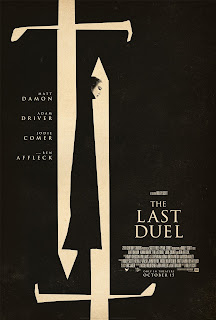
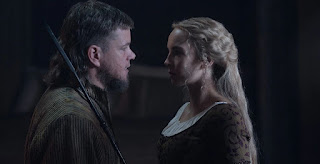
Ridley Scott’s Epic drama The Last Duel is a film that's all too rare on the current field of Hollywood battles. At first we chalk it up to opening jitters, an awkward if handsomely shot peek through one of Sir Ridley’s self-serious windows into the past. And we stay in that creeky register as we follow Jean de Carrouges, a valiant fighter and man of honor with all the luck of Job. First the plague claims his first wife and child, then he is forced to pledge fealty to Count Pierre d’Alençon (Ben Affleck), who treats the squire with nothing but disdain. And then, to add a poisonous cherry on his sundae of shit, his lifelong friend Le Gris starts claiming all of de Carrouges’ inheritance. Thick-skulled, rough, and bearing a nasty scar on his cheek, Carrouges is hardly a poster boy for romantic chivalry. When he proposes marriage to Marguerite (Jodie Comer), a disgraced nobleman’s beautiful daughter, he doesn’t exactly sweep her off her feet; given her family’s financial situation, it’s literally an offer she can’t refuse, and the modest spoils of her dowry accrue to his cause. Told in three chapters that each follow a different perspective, “The Last Duel” doesn’t play “Rashomon” with the question of sexual assault. The film is unambiguous about Le Gris’ crime, and so too is his victim, who tells her husband point blank, “He raped me.” Damon and Affleck picked up the pen, teaming with Nicole Holofcener for the segment of Marguerite. 

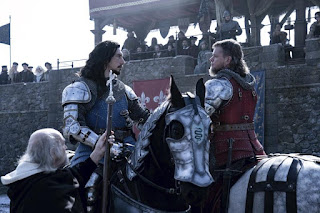
Damon effortlessly slips into the hapless doof role he trots out, somewhat brusque but loyal to Marguerite. Driver reverts to cerebral hulk, self-satisfied and smug about it; and Affleck is just an absolute joy whenever he’s onscreen. Jodie Comer finds surer footing in the final chapter where she excels. As the film reframes the whole sordid affair from Marguerite’s view, it also shows its cards in a way “Rashomon” would never dare, which is, a real break with the framework. But in seizing this newly found moral clarity and building toward the bruising showdown between Carrouges and Le Gris, Scott kicks the ball back toward his side playground while giving Comer room to shine. De Carrouges sees himself as a good and brave man, unfairly treated by his superiors. When he returns from a trip, his wife informs him that she was raped by Le Gris while he was away. De Carrouges vows to bring him to justice. To Le Gris, his sex act with Marguerite might be bold but driven by passion, and perhaps mutual longing—though certainly it's not consensual. Damon and Affleck wrote the first two sections, and handed over the third, of Marguerite’s account, to Nicole Holofcener.

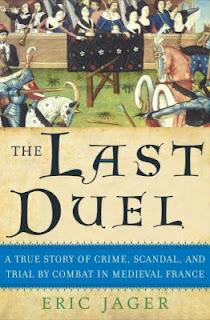
The film, adapted from Eric Jager’s 2004 non-fiction book about the true history, has naturally been building to this new filmic account. Jodie Comer takes control of the film as it captures Marguerite’s experience being pressured to birth an heir (something that can only happen, she’s told, if she also finds pleasure in sex with her husband) and her savvy stewardship of the castle while De Carrouges is away. Many of the dueling perspectives of the film—slyly self-aware—reverberate with today’s #MeToo struggles. It’s tempting to think “The Last Duel” should have just been Marguerite’s account, but so much of the film’s pleasure is seeing Damon, Affleck and Driver—each playing a different type of guy—gradually dismantle and even lampoon their own charms. Through all these overlapping approaches, “The Last Duel” reveals itself as something all too rare on the current Hollywood field of battle: an intelligent and genuinely daring big budget melee that is—above all else—the product of recognizable artistic collaboration. Source: indiewire.com

The Last Duel is simultaneously a complex and unambiguous exercise of old school cinema. It seems to explore some shades of gray by showing how different people may have a different interpretation of a same event. However, applied on a topic as sensitive as rape, especially in our #MeToo era, that exploration becomes increasingly difficult, due to the movie operating under a moral imperative that there must not be a sliver of ambiguity left for the audience about what really happened here, who's right and who's wrong. In Rashomon, the different narratives are way more largely contradictory and the whole point is that there may be no such thing as "the truth" free of biased subjectivities. But The Last Duel cannot follow that path, because of the intentions of Ridley Scott and specially Matt Damon in trying to update this sensitive subject to a modern audience. "You Shall Be Damned!!—howled by a vengeful De Carrouges imparting justice in name of his wife—is one of the most satisfying lines of any movie all this year.

"The accusations that have now come out against Weinstein are the kind of sexual predation that keeps me up at night", Damon told Deadline in 2017, adding that he had never seen inappropriate behaviour during time spent making films with Weinstein, but he suspected of "his womanizing ways." "This type of predation happens behind closed doors, and out of public view. If there was ever an event that I was at and Harvey Weinstein was doing this kind of thing, I would have stopped it. I would never, ever, ever try to ignore a story like that. I just wouldn't do that. It's not something I would do, for anybody." More recently Damon reiterated: “Weinstein was a bully. These are legendarily badly behaved people. I think it’s sad when people have abused their power just because they were successful.”

On the surface, the structure of The Last Duel seems to be about how our views may be biased and our memories may be colored. And on several occasions after the fact, we're led to understand that Jacques Le Gris genuinely doesn't believe that he raped Marguerite. There was something potentially risky, but not uninteresting, to explore here, about what we would call "rape culture" nowadays. It's hard to believe that Le Gris, who has been established as a womanizer, spending seemingly half his night in orgies lifted straight from Game of Thrones, has no idea that this lady was not willing. Source: bbc.com

Facial cues could inform heterosexual women, but not men, if a potential mate is more interested in casual sex than a committed relationship. Researchers found that women are really good at judging which men are only interested in short-term relationships just by reading their faces. Apparently, men with longer faces, higher foreheads, longer noses, and larger eyes tend to be more open to casual sex, and women can pick up on it. The team of researchers from Macquarie University in Australia embarked on this study starting from a debate about the mechanics of attraction in humans. The Australian researchers hypothesized that being able to tell whether someone is interested in a monogamous relationship or casual sex could be the kind of information that humans may be able to extract from visual cues, such as facial traits. 103 white individuals, both male and female, had to complete a survey that assessed their level of sociosexuality. The researchers then associated the sociosexuality scores with facial shape characteristics in men, but not in women where no reliable association could be found. Interestingly, women’s perception of male sociosexuality matched the men’s self-reported sociosexuality scores, showing that women can predict some of men’s sexual desires and intentions from reading their faces. However, males were terrible at this task. Their perception of women’s sociosexuality did not match the women’s self-reported attitudes and behaviors towards casual sex. Lastly, the researchers used the data gathered in the previous studies to make computer-generated pairs of portraits representing high- and low-sociosexuality faces. Participants correctly identified high-sociosexuality faces better than chance—yet again, just in men and not women. The researchers suspect that the sociosexual orientation reflected in males’ faces may be due to variable levels of testosterone. Men with higher testosterone tend to have certain traits as a wider brow, a longer nose, and a wider distance between the eyes. Often, these high-testosterone men tend to express more promiscuous tendencies. Source: www.sciencedirect.com

Friday, December 31, 2021

West Side Story, Don't Look Up, Leo DiCaprio, The Talented Mr. Ripley, Matt Damon

With five Academy Award nominations and a win for “The Revenant,” Leonardo DiCaprio has established himself as a Hollywood icon, with nearly $3 billion dollars of global box office to his name. In “Once Upon a Time in Hollywood,” DiCaprio played a washed-up movie star at the end of his tether — which is perhaps the biggest stretch yet for an actor with such an esteemed pedigree and enviable body of work. Adam McKay’s end-times satire “Don’t Look Up” finds DiCaprio back in the awards conversation for his turn as a flustered astronomy professor heralding a planet-annihilating comet to deaf ears. DiCaprio gets many a chance to chew the scene — including in a few pivotal, “Network”-inspired, blistering monologues about the idiocy of the modern world.  Source: indiewire.com
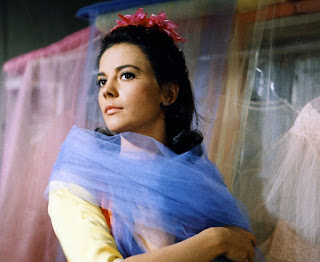
First time around, West Side Story was a musical tragedy. The Broadway stylization of American youth (created by Arthur Laurents, Jerome Robbins, Leonard Bernstein, and Stephen Sondheim) was so empathetic toward rock ’n’ roll and restless urban subcultures that when the film version appeared, adults and teenagers all accepted it. They understood that art made by others could represent universal human experience. But in our millennium, the doomed romance of Polish-American Tony with Puerto Rican Maria (star-crossed lovers translated from Shakespeare’s Romeo and Juliet) no longer embodies a common plea for age, race, and cultural tolerance. Now Steven Spielberg’s version of West Side Story seems to reject what once was genuinely unifying in American popular culture. Spielberg and Tony Kushner, his collaborating screenwriter, set the story in the 1960s, specifically when the Upper West Side of Manhattan was undergoing urban renewal. Slum-clearance signs announce preparation for what is now the Lincoln Center fine-arts space. Spielberg and Kushner’s race-war conceit self-consciously heightens national antagonism; they make America’s racist past inescapable. It is always the 1960s.
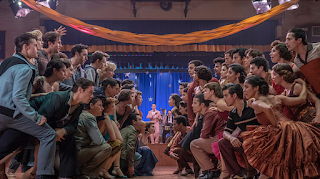
The threat of injustice is evident when gangs meet, dancing into their positions with the muscular masculine aggression missing from Robbins’s original choreography. The supercharged threat is Spielberg and Kushner’s way of emphasizing violent rivalry. But by film’s end, there’s no more reference to Lincoln Center and its future dominance as a bastion of Western fine arts (the wrecking balls poised over the dilapidated cityscape were just destruction motifs) because Spielberg and Kushner themselves share those commanding heights. They’re in the process of transforming — demolishing — culture according to Millennial rules. This is an inferior West Side Story because it isn’t an honest update. Having fallen under Kushner’s Communist, anti-American influence, Spielberg sinks to self-parody when he attempts to endear Tony (Ansel Elgort) and Maria (Rachel Zegler) as victims of a harsh society — aliens too gentle for this world. Revising American cultural history this way erases West Side Story’s original, unrepeatable, indisputable impact. The closing song “Somewhere” once inspired many renditions (even a poignant, if unctuous, civil-rights theme by Diana Ross and the Supremes) that felt like secular prayers for humanity. Can we ever be so open or romantic again? Spielberg shrinks the spiritual aspiration that once made his popular art transcendent. First time out, West Side Story functioned as tragedy and cultural triumph. Second time, it’s a woke farce. Source: nationalreview.com
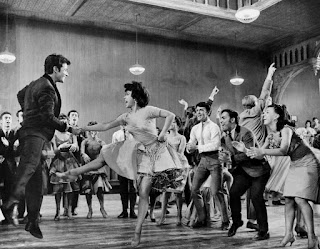
Whereas Rock Culture shown in West Side Story was steeped in hedonism and sensualism (despite its serious and/intellectual aspirations), Folk Movement was about socio-political commitment and/or fidelity to the simple essence of humanity unvarnished with cosmeticizing effect of capitalist consumerism, the main expression of which was advertising that presented idealized images (that were hardly accurate representation of humanity); of course, much of advertising today indulge in anti-idealism, a freak-show that also has little use for the normal spectrum of humanity. The Anti-Ideal is the flipside of the Ideal, both driven more by agenda than any reflection of reality. Ideality presents humanity better than it really is, whereas Anti-Ideality makes it seem worse… but for the perverse twist that the Anti-Ideal is promoted as the higher ideal. Sixties Counterculture fell into the Rousseauean trap. Its adherents and spokespeople really believed that all the problems of the world were the result of repression, organization, hierarchy, management, and order. They fell for the fallacy that, because much harm arose from organized power, order itself must be bad, therefore dissolution into happy disorder would automatically liberate humanity from its problems. Source: unz.com

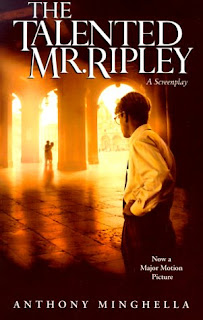
“If you wanted to be cheerful, or melancholic, or wistful , or thoughtful, or courteous, you simply had to act those things with every gesture, Tom thought. But they were not friends. They didn't know each other. It struck Tom like a horrible truth, true for all time, true for the people he had known in the past and for those he would know in the future: each had stood and would stand before him, and he would know time and time again that he would never know them, and the worst was that there would always be the illusion, for a time, that he did know them, and that he and they were completely in harmony and alike. For an instant the wordless shock of his realization seemed more than he could bear.” ―Patricia Highsmith, The Talented Mr. Ripley (1955)
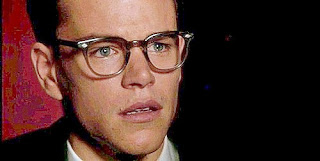
Whereas Highsmith’s Ripley offers an unusual and fascinating insight into the mind of a genuine amoral narcissistic sociopath, Damon’s Ripley is just a vaguely pathetic criminal of opportunity. What makes Ripley scary in the novel is that he doesn’t feel any emotional at all as he kills–and he certainly doesn’t sob and apologise while he’s bludgeoning/strangling you to death. The fascinating and multi-layered psychology of Highsmith’s Ripley is drained of complexity by Minghella. According to Highsmith, the character of Ripley is not a homosexual. That was just Marge’s jealousy speaking. A lesbian herself, Highsmith certainly had no hang-ups about homosexuality. She just didn’t see Ripley that way. In Minghella’s film, however, Dickie Greenleaf is fearsomely handsome and charismatic, and Tom Ripley doesn’t just fall in love with his money and lifestyle, he falls in love with his persona too. Also, the film is far more adept at making the audience Ripley’s accomplices than Highsmith’s novel. Minghella’s Ripley was brilliantly portrayed by Matt Damon, his character completely plausible as a well-intentioned (at first) and sensitive, if insecure and impulsive, young man who is driven over the edge by being seduced for someone so shallow and boorish as Dickie. The realization that the sympathetically-portrayed and tragic character is in reality a sociopath is a dramatic shock that gets you right in the guts. The timing of Minghella’s movie within three years of the murderous rampage of Andrew Cunanan, in which the fashion designer Gianni Versace was killed, makes one wonder if it’s merely coincidental. Source: unz.com
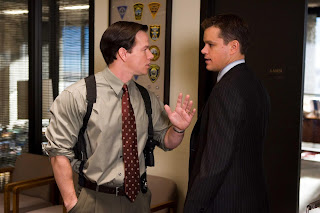
-Charlie Tozier: In a fight to the death between Leonardo DiCaprio, Edward Norton and Ben Affleck, who do you think would emerge victorious? No weapons.

-Matt Damon: Ben is a lot bigger than those guys, he’s hopelessly uncoordinated, but he is a big dude with a huge reach advantage. Edward Norton is very smart though, so he might think of some brainiac way to pit the others against each other and be the last remaining man. I’m not counting Leo DiCaprio out. I’m just saying I don’t know about Leo. Anyway, Mark Wahlberg would kill all of them. 
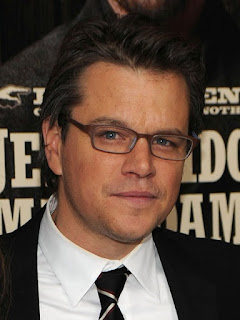
There is a certain type of hardcore Bostonian that Mark Wahlberg has represented, opposite the more illustrious Bostonian actor Matt Damon. Wahlberg, Damon and Affleck came from rough areas from Boston. Wahlberg grew up in Dorchester, one of the most dangerous areas of the city, whereas Ben Affleck and Matt Damon grew up in Cambridge, which also has conflictive areas, but it's more secure if you are familiar with its environment. Historically, Boston was the scene of several key events of the American Revolution, such as the Boston Massacre, the Boston Tea Party, the Battle of Bunker Hill and the siege of Boston. Upon American independence from Great Britain, the city continued to be an important manufacturing hub, a thriving center of scientific research, as well as a center for education and culture. 

To date, households and businesses in Boston claim the highest average rate of philanthropy in the United States. In 1950, Whites represented 94.7% of Boston's population. From the 1950s to the end of the 20th century, the proportion of non-Hispanic Whites in the city declined. In 2000, non-Hispanic Whites made up 49.5% of the city's population, making the city majority minority for the first time. In 2010, the US Census Bureau estimated the non-White population had rebounded with increased Latin American and Asian populations, which indicate a non-Hispanic White population of 47 percent (other reports give even lower figures). Harvard University is an Ivy League University located in Cambridge, Massachusetts. Founded in 1636 and named for its first benefactor, the Puritan clergyman John Harvard, it is the oldest institution of higher education in the United States and among the most prestigious in the world. Matt Damon attended Harvard University from 1988-1992, studying Bachelor of Arts and English. His professor of theatre Anthony Kubiak gave him an A and encouraged him to appear in theater plays. In Harvard Damon wrote the first draft of "Good Will Hunting", and as Damon said later: "I showed it to Ben Affleck and the rest is history."
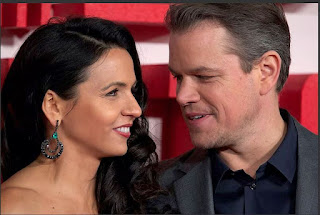
-Matt Damon: I’m lucky to be the only guy in the house. It’s a man’s dream. The testosterone deficit at home makes me very special: You learn a lot by looking at the world from the female point of view. I do get confused with Mark Wahlberg a lot. I was walking down the street with my kids, and this guy screamed “Mark Wahlberg!” I just kept walking, because I’m not Mark, and he kept screaming “Mark Wahlberg, I see you! Don't walk away! MARK WAHLBERG! WE KNOW IT’S YOU!” and then he runs up to me and he says, “I love your work!” And then this woman comes up, and says “I love your family, tell your brother I said Hi!” So I said “Yes, I’ll tell Donnie Wahlberg you said Hi.” If people are insistent, there is no convincing them I’m not Mark, so I just become him and try to be nice to them. My kids were with me and there’s no easy way to explain that situation to them.
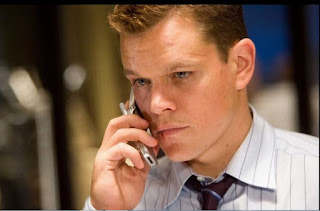
“The Departed" (2006), directed by Martin Scorsese, remains a well-crafted, hugely enjoyable pulp crime flick, that certainly improves on its subject matter, the Hong Kong film "Infernal Affairs." The film's chock-full of pleasures and Matt Damon's performance, while not the most immediate, is the one that lingers long afterwards. Simply put, Damon is astounding, the best he's ever been, and looking back now, it's astonishing that he was overlooked in awards season in favor of co-star Mark Wahlberg. Scorsese finally won that elusive Oscar with this Boston crime thriller that had DiCaprio as a cop infiltrating the mob and Matt Damon as a mobster mule infiltrating the police force. It’s an intricate, fascinating tale of competing cat-and-mouse games, but the director and his screenwriter, William Monahan, infuse it with so much tragedy that it winds up becoming something almost mythic. Source: rollingstone.com
Thursday, December 23, 2021

Merry Christmas! (Die Hard, White Christmas)

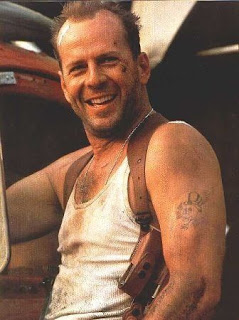
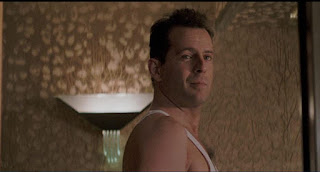
It’s that time of year for hunkering down to watch a Christmas film with the family – and to hold the annual debate over whether or not Die Hard (1988) actually counts as one. Bing Crosby and Danny Kaye it’s not, but Die Hard has yule coming out of its ears. Against the backdrop of a Christmas party, Bruce Willis plays cowboy to Alan Rickman's villain, which on its own should be enough to light up your Christmas Day. It’s got a rescued relationship as a Christmas miracle, and our boy John McClane spends more time in an air duct than Santa spends in chimneys with the help of Reginald VelJohnson, who let’s face it is his Christmas elf. Also, let’s not forget this Christmas gem: “Twas the night before Christmas, and all through the house, not a creature was stirring, except the four assholes coming in the rear in standard two-by-two cover formation.” The follow-up? McClane now has to rescue Dulles Airport on Christmas Eve from terrorists trying to free a drug lord while crashing planes in the process, with his wife on one of the planes. As both director John McTiernan and writer Steven De Souza have confirmed that Die Hard is a Christmas movie, then the creative case would seem very much in favour.

There are nine Christmas motifs detected in Die Hard:

-The basic narrative situation of Die Hard is a man returning to his family for Christmas.

-His wife is called Holly.

-It takes place on Christmas Eve. Not Thanksgiving or the Fourth of July. It could have been set any week of the year, but wasn’t.

-The chief villain Hans Gruber (Alan Rickman) explicitly invokes the Christmas spirit: “It’s Christmas, Theo, it’s a time for miracles.”

-Gruber is a classic bad capitalist villain: he’s there to steal money. Just as Old Man Potter does in It’s a Wonderful Life.

-The soundtrack features Christmas tunes new and old: Run DMC’s Christmas in Hollis and Frank Sinatra’s rendition of Let it Snow.

-Santa Claus makes an appearance (in the form of a dead terrorist).

-The film ends with the of character of limo driver Argyle (De'voreaux White) looking forward to New Year’s Eve.

-And point nine, the clinching argument, perhaps, is that Christmas is a socially invented tradition, and like all invented traditions it continues to adapt and evolve. Films don’t need to include religious references or a man in a red suit, Christmas changes every year and as such what constitutes as a Christmas flick has expanded hugely. 

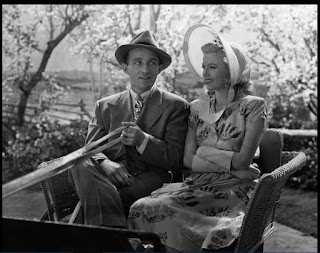
The commercial argument is that Christmas movies are released at Christmas and are generally intended for family audiences. However, Die Hard was a summer release (15 July 1988) in the United States and very obviously for adults. However, this argument that a summer release can’t be a Christmas movie does not hold up to even the most cursory examination. That perennial seasonal favourite Holiday Inn, in which Bing Crosby warbles Irving Berlin’s White Christmas, was also a summer release (4 August 1942), and no one argues that isn’t a Christmas movie. Even the remake, White Christmas, was released in mid-October 1954. So proximity to Christmas is not necessarily a criterion for a Christmas film. Source: theconversation.com