WEIRDLAND

Ad Sense

Sunday, February 10, 2019

Listen to Me: Enduring Legacy of Buddy Holly


Released on 16th November 2018, this newly recorded album features Buddy Holly’s utterly distinctive original vocals and guitar playing set to exquisite arrangements performed by the Royal Philharmonic Orchestra. In that last recording session, at the Decca Studios in New York, the star was joined by an 18 piece orchestra, fronted by Dick Jacobs, bringing strings to rock and roll. They recorded four tracks: ‘True love Ways’, ‘Raining in My Heart’, ‘Moondreams’ and ‘It Doesn’t Matter Anymore’ all of which are soaked in strings, clearly demonstrating a new direction for Holly. Recorded in London’s Angel Studios, and produced by Nick Patrick, the man behind the hugely successful Elvis Presley and Roy Orbison orchestral albums, ‘True Love Ways’ truly reflects Buddy Holly’s love for strings, having learnt to play the violin as a child, that continued all his life. Beloved tracks the singer recorded with The Crickets such as ‘Everyday’, ‘Peggy Sue’ and ‘That’ll Be The Day’ are all included, with orchestrations that invigorate, rather than overwhelm, the rock and roll of which Holly was king. Holly's widow, Maria Elena, explains that her husband thought then that the rock & roll era had peaked: "Buddy felt orchestral music in a popular vein was where the future lay, so he wanted to write, record, explore and innovate that style. So what better combination than the Royal Philharmonic and Buddy's music. It's just beautiful." This is what Buddy would've wanted done." – Larry Holley, Buddy Holly's brother. Source: www.prnewswire.com

In 1986, Rolling Stone magazine ranked Holly as Number 13 among its “100 Greatest Artists.” That same year, he became a charter member of the Rock ‘n’ Roll Hall of Fame. Lacking the flamboyance of Little Richard and Jerry Lee Lewis or the sexy, movie star charisma of Elvis Presley, Buddy Holly was akin to the boy next door. Holly’s bespectacled face never graced the covers of teen magazines or appeared on the big screen. Baptized at age 14, Holly confided to a pal: “It looks like every time you screw up, God is there to put his arms around you and say, ‘Let’s get going again!”’ During Buddy’s senior year of high school, he served as vice-president of the Distributive Education Club; a program, which allowed students from poorer families to attend classes in the morning and work in the afternoon. Consequently, Buddy became a part-time employee, first at Glen Decorating, followed by Davidson Printing Works. Buddy eventually became a talented draftsman, which he considered as a back-up occupation if he failed to make it in the music world. 

Holley’s long-time girlfriend, Echo McGuire, was planning to attend a religious school in Abilene, Texas, 165 miles southeast of Lubbock. Many, including Buddy’s brother, Larry, “felt like he might marry her,” after the couple graduated from high school. Echo’s departure for college, however, was a significant step toward ending their adolescent relationship. “Buddy and Elvis got along pretty good,” Larry Welborn explained. Much to the chagrin of his original manager, Hi Pockets Duncan, in February of 1956, Buddy traveled to Clovis, New Mexico, 90 miles northwest of Lubbock, where Norman Petty had constructed a recording studio. “Whatever you do, don’t go to Clovis. Norman Petty has a bad reputation for taking advantage of kids,” Hi Pockets warned Buddy. A headstrong Holly, not yet 19-years-old, disregarded Duncan’s advice; a decision he would later regret, many times over.


"Of all the 50's rock and roll giants, Buddy Holly was the most selfless, the most talented and the most likable." —"This'll Be the Day: The Life and Legacy of Buddy Holly" (2009) by Professor Maury Dean

-Lance Monthly: Do you think that Holly was justified in wanting to distance himself from Norman Petty? -John Beecher (co-author of Remembering Buddy: The Definitive Biography Of Buddy Holly): Yes I do. Norman never wanted an artist to be big. Norman was a great engineer/producer in his own environment, but out of his depth in the big studios of New York; and the "biz cats" in the big city knew what he was up to, eventually shunning him. For a while Norman was powerful, but with the power came greed and carelessness and that was his undoing. Source: www.musicdish.com

Norman Petty’s loyal bookkeeper, Norma Jean Berry, had abandoned her career as a local journalist. The pleasantly plump, bespectacled Berry appeared mannish, especially when dressed in blue jeans and penny loafers. Intermittent rumour had it that Petty's wife Vi and Norma Jean carried on a lesbian relationship; that Norma Jean and Petty had once had an affair; even that the three participated in troilistic sexual acts. Maria Elena Holly believed the mannish-looking Norma Jean had sexual designs on her, and kept her distance. During a late-night recording session, Maria Elena chose to sleep in Buddy’s Cadillac, rather than the studio’s bedroom. The truth appears to have been that all three, Norman & Vi Petty and Norma Jean Berry, for different reasons, were virtually sexless, and Norma Jean clung to the Pettys as her surrogate family. Norman Petty, however, seemed fixated on his protegé Holly and now wife Maria Elena's sexual relationship. In one occasion, Peggy Sue Allison remembered: "Buddy and Norman Petty were just about halfway to the door where the reception room is, and Maria said, ‘Buddy, Norman looked up my skirt!’ We absolutely froze. All the blood just drained from Buddy’s face." 

Any recordings made at Petty’s studio and later picked up by one of the many record labels that did business with Norman, came at a high cost to performers. Petty not only shared in the profits from record sales, but also insisted on a portion of the song-writing royalties, even when he had no role in their composition. Nor-Va-Jak secured publishing rights for any records produced at Norman Petty Studios. Petty would no doubt help Holly, but in exchange, would demand partial song-writing credits, thus sharing in the royalties for compositions he had no role in creating. Holly, at age 19, was simply too impatient to think about money or seriously question Petty’s shady reputation. All he knew was that Norman Petty had transformed Buddy Knox and Party Doll into overnight sensations. As Hi Pockets Duncan had predicted, Petty’s offer to sell Holly’s record came at a steep price—both That’ll Be the Day and I’m Looking for Someone to Love would be published by Nor-Va-Jak. Petty also insisted that his name be added to the song-writing credits, explaining that disc jockeys who recognized an established performer’s name on the record would be more apt to give it playing time. Such a move guaranteed that Petty would receive an equal share of the song-writing royalties, which an eager and naïve Buddy did not yet fully realize. Niki Sullivan summarized the song-writing process in Clovis: “Buddy was the major contributor, or the originator on the idea of the song. We (The Crickets) would all contribute, but it was Buddy who was the creator.”

In the summer of 1957, Buddy Holly did become romantically involved with a married woman, June Clark. The relationship began when the Crickets started rehearsing at the Lubbock home of their friends, James “Nig” Clark and his wife June. In their late 20s, the Clarks were rock and roll fans, and from the very beginning, ardent supporters of the Crickets. Some of their friends believed that Nig and June remained married solely for the benefit of their son. Buddy’s attraction to June, however, appeared to be driven by more than just youthful lust. Buddy’s infatuation was such that he would linger for hours at Hull’s Drug Store, where June worked behind the cosmetics counter. June grew concerned that Buddy’s conspicuous behavior would alert Nig to their clandestine affair. Buddy, who seemed to care little about what others thought, told June that he would give up music, if she would leave her husband and run away with him. Whether that promise was made during the height of passion or represented genuine devotion, it was truly a profound statement; Buddy would be abandoning his long-standing dream of becoming a professional entertainer, just as he was on the cusp of achieving stardom. They began a risky, on-the-wing romance, stealing kisses over coffee-cups. To further complicate matters, June had begun to suspect that Jerry Allison was also ‘sweet’ on her. ‘I felt I should tell Buddy that because Jerry was his best friend. Buddy acted like we were the only two grown-ups involved. “Jerry’s young,” he said. “He’ll probably get over it.”’ The intensity of Buddy’s feelings began to alarm her. Forgetting the need for discretion, he phoned her constantly, and also took to hanging around the Hull drugstore. ‘He’d just stand there staring at me, till it got to be really embarrassing and unnerving.’

In the fall of 1957, Buddy and June were reunited under the camouflage of a party for Buddy Knox; June's sister Tuddie lent them her apartment on West 10th Street to resume their love affair. When Tuddie needed to be at home, they would meet to make love at a nearby apartment hotel. ‘He told me time after time that it wasn’t just a crush – that he wanted to have a permanent relationship with me,’ June recalled: ‘I seriously thought about it, because I did have feelings for him. The last time we were due to be together, just before he left on that first big national tour, we ended up just talking on the phone. Buddy told me again that he wanted me to leave Nig and go away with him. I kept saying I couldn’t because I had a little boy. It went on for about an hour, him begging, me saying no I just couldn’t. In the end, there was nothing else to do but just hang up.’ 

Donnie Lanier with his sister June Clark in Lubbock.

Buddy's tortuous love relationships (Echo McGuire's chaste courtship, his impossible love affairs with Lubbock's wild girl and the married June Clark) would be eclipsed by his true love, Maria Elena Santiago. In her teens, Maria Elena had settled into her Aunt Provi’s apartment, located on 10th Street in Greenwich Village, and completed school in New York City. After graduating from high school, she worked for a time at St. Vincent’s Hospital as a translator for Spanish-speaking patients. Maria Elena also served as her aunt’s assistant, packing luggage, purchasing clothes, and serving as a hostess during the cocktail parties Provi held at her apartment for Peer-Southern song-writers. Buddy found Maria Elena to be unlike any other woman he had met—attractive, intelligent, articulate, sophisticated, and a good listener. Likewise, Maria Elena felt an immediate connection, as if she had known Buddy “for years already.” She was particularly impressed by his humor as well as his maturity. Provi, who was about to embark on a business trip, offered Maria Elena her credit card to purchase a wedding dress and other accessories. Buddy cavalierly objected, promising to pay for whatever items his fiancé might need. But Norman Petty was totally opposed to Buddy getting married. He warned Holly that a married rock and roll star would lose many female fans. Petty even told Buddy that Maria Elena was a “cheap girl,” who “picked up” numerous singers. This scurrilous rumor had supposedly been passed along to Petty by an executive at Peer Southern. Sensing that Buddy was about to punch Norman, she quickly intervened: “Let’s get back to New York.” The seeds of discontent between Holly and Petty had been sown well before Buddy met Maria Elena. Above all, Buddy was tired of Petty’s calculated snubs to Maria Elena. 

Norman Petty, sensing that his days with Holly were numbered, began quietly undermining The Crickets. Petty told Jerry and Joe B. that Maria Elena was forcing Buddy to move to New York City. If the Crickets followed him, Norman warned them that they would be financially exploited by New York record executives. Nearing the end of 1958, Holly had learned how to collect and distribute tour fees, function as a road manager, produce records, and manage the band’s financial affairs, all without Petty’s guidance. Joe B. eventually came to understand that Petty had a broader agenda; he was determined to extract personal and financial revenge on Buddy Holly. Joe B. explained Petty’s counterproposal in greater detail: “It’s not Maria that broke the group up; I felt like Norman Petty’s the one who broke the group up. Norman said, ‘Look, let’s stay down here, where we have control of everything.’ Norman said he had ‘all Buddy’s money in the bank, and he'd starve to death.” Jerry Allison likely confused the sequence of events, but he never blamed Buddy for their break-up: “I am sure that Buddy wasn’t fed up with us. He was fed up with Norman Petty. Actually, we were unhappy we hadn't gone to New York with him. After Buddy moved to New York, he wrote a dozen songs which I thought were some of his very best songs, like "Learnin' The Game", "Love Makes It Tough" and "Peggy Sue Got Married".” Since they could not afford a secretary in New York, Buddy and Maria Elena kept up with Holly’s fan mail. Buddy personally answered each letter. 

Even though he was unhappy about the WDP tour, angered by Norman Petty’s refusal to relinquish his royalties, and hurt by Jerry’s and Joe B.’s betrayal, Holly still did try to maintain a smiling face. For the remainder of his life, Petty never cleared himself of allegations that he had cheated Buddy Holly and the Crickets. By the early 1970s, Petty was in dire financial straits. He purportedly began writing a book about his life as a producer of different musical artists, but never finished it. Larry Holley: "I personally think Buddy would have reached the very pinnacle of the music world if he had got to live longer. Norman Petty cheated Buddy out of millions of dollars by putting his name on every song that Buddy wrote. Also, it's my opinion that The Crickets (Jerry Allison and Joe B.) both deserted Buddy, but they keep riding on his shirttail. They can't write good songs, but just like Norman, they have got their name on songs they could never have written." Jerry Allison has freely acknowledged it: “We’ve pretty well proved that the Crickets without Buddy Holly aren’t too hot of an item.” Allison's ex-wife Peggy Sue Gerron explained in March of 2017: “I don’t know if Buddy was in love with me! I adored Buddy and he was one of my closest friends. I don’t know how he really felt, because he didn’t discuss it with me,” confirming Maria Elena's suspicions that Peggy Sue's recollections were mostly fabricated.

Even though it was freezing outside, the Surf Ballroom was decorated like a Florida night club. Palm trees greeted visitors in the lobby and were positioned on either side of the stage. The vaulted ceiling, overlying the 6,300-square-feet maple wood dance floor, was blue, with projected images of drifting clouds. Wooden booths, with green, padded leather upholstery, lined the periphery of the room, to accommodate non-dancers. Bob Hale, the 25-year-old disc jockey at KRIB in Mason City, remembered how impressed he was by Buddy Holly: “From the moment the bus arrived, Buddy took charge. He directed the equipment set-up, discussed the upcoming events, and decided the performance order, and did so while sitting at the piano playing as he spoke. He was only 22-years-old, but was clearly in charge of everything and everyone. It was equally apparent that those he led respected and liked him, while looking to him for direction.” Buddy developed a bond with the streetwise Dion  DiMucci, who had a history of alcohol, marijuana, and heroin abuse. Having battled his personal demons, Dion considered Holly a role model: “I admired how together he was.” Before the first show, Hale chatted with Buddy and the Big Bopper, sharing a common bond; all three of their wives were pregnant. Holly openly discussed his ongoing dispute with Norman Petty: “I’ve got to get this stuff straightened out. One problem with being on the road, you don’t know what’s going on back there.” When Valens took the stage, Hale remembered “the girls went crazy over Ritchie.” Buddy’s performance, however, “almost blew the roof off. They didn’t want to let him go,” Hale recalled. Tommy Allsup remembered that Buddy was infuriated with Petty’s nefarious bookkeeping: “When this tour is over, I’m going back to Clovis and I’m going to kick Norman Petty’s ass. I’m going to get my money out of that studio, one way or the other.” During the drive to Clear Lake, the bus developed heater problems, forcing the group to stop at a service station in Praire du Chien. Buddy called his attorney in New York City, to discuss the ongoing dispute with Norman Petty. “He came back on the bus and was mad. I mean he was bad mad; the maddest I ever saw him,” Waylon Jennings recalled. At the same time, Petty was maligning Buddy’s character, describing him as child-like, with “a tendency to want to make contracts and get out of them.”

Many music historians and performing artists believe the death of Buddy Holly marked the beginning of the end for the first phase of rock and roll. “Rock ‘n’ roll died in ’63, and became Rock. In the later 60s, rock ‘n’ roll splintered. It became surf rock, psychedelic rock, protest rock, and drug rock. It wasn’t the fun rock ‘n’ rock roll Buddy created,” Holly historian, Bill Griggs, opined. Jerry Lee Lewis remembers Holly as “a real champion” and “a true gentleman,” claiming that: “He was my buddy. He was hotter’n a pistol, and he could play the guitar as good as Chet Atkins. He was a gentleman, and he never lied, he never cheated or anything like that on his girlfriend.” Buddy went on to tell Jerry Lee about a beautiful girl he’d met in New York City named Maria Elena. He’d already proposed to her on their very first date. “If you love her,” said Jerry Lee, “it don’t matter what nobody else thinks,” was Jerry Lee's advice. “John and I started to write because of Buddy Holly,” Paul McCartney admitted. “Buddy Holly had it all,” the Rolling Stones’ Keith Richards proclaimed. “Something about him seemed permanent and he filled me with conviction, it gave me the chills,” Bob Dylan said of Holly on his Nobel speech in 2016. It is hard to conceive that Buddy Holly, at any age, would have been as ostentatious as John Lennon, who in 1966 opined that the Beatles were more popular than Jesus Christ. Stardom never appeared to go to Holly’s head or disrupt his long-standing relationships. “We loved Buddy. He was a good man and we could never detect that success changed him one bit. He was kind, humble, and excessively nice,” recording artist Gary Tollet, acknowledged. Less than two months before his death, Holly was not only willing to play during a KLLL remote radio broadcast, but was also planning for a homecoming concert in Lubbock. 

Buddy Holly was always very generous. Gary Tollet’s wife, Ramona, summarized Holly’s willingness to give, even when the recipient was less than generous toward him. Buddy’s generosity and kind-hearted nature were accompanied by naïvete, particularly in the early stages of his brief career. In May of 2017, Sonny Curtis remembered his long-lost bandmate and close friend: “He was very confident, a great singer, guitarist, song-writer, which made him a trailblazer in rock and roll. His talent was extraordinary and he was a good ole boy.” Eager to become a recording star, an overly-trusting Holly was ripe for exploitation by Norman Petty. When Holly became fully aware that he was being financially exploited by Petty, he was nearly broke. In dire financial straits, Buddy embarked on an ill-advised, but necessary tour that culminated in his premature death. In today’s world, filled with mass shootings, acts of terrorism, and musical genres that glorify violence, we need Buddy Holly. In the words of Henry David Thoreau: “In a world of peace and love, music would be the universal language.” Sources: —"Listen to Me" (2017) by Jeffrey K Smith and "Rave On: The Biography of Buddy Holly" (2011) by Philip Norman

A study has found that golden oldies stick in millennials’ minds far more than the relatively bland, homogenous pop of today. A golden age of popular music lasted from the 1960s to the 1990s, academics claimed. Songs from this era proved to be much more memorable than tunes released in the 21st century. Lead researcher Dr Pascal Wallisch, from New York University in the US, said: ‘The 1960s to 1990s was a special time in music, reflected by a steady recognition of pieces of that era-even by today’s millennials.’ During this period songs reaching the top of the US Billboard charts were significantly more varied than they were between 2000 to 2015, said the scientists. Songs selected for the study included those that reached number one on the Billboard Top 100 between 1940 and 1957, and the top slot on the Billboard ‘Hot 100’ from 1958 to 2015. Source: metro.co.uk
Wednesday, February 06, 2019

Buddy Holly & The Winter Dance Party


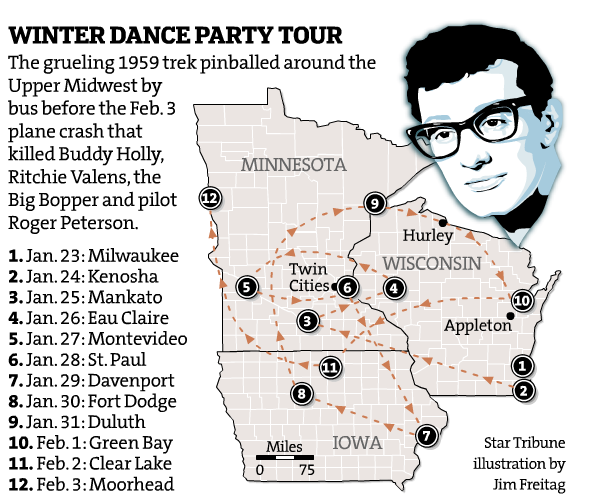
Larry Lehmer wrote down in 1997 the most concise and sharp look at the Winter Dance Party. “The Day the Music Died” has stood the test of time and proven itself as a “must have” for any serious rock and roll fan. Lehmer was able to gather most of the known material on the crash and present it in such a way that answered many longstanding questions. It also posed its own series of disturbing and troubling questions that have yet to be resolved. Martin Huxley and Quinton Skinner assembled a book of the same title as Lehmer’s for the VH1 book series, “Behind the Music.” Want to see a Buddy Holly fan sent into a fit of apoplexy? Mentioning of Ellis Amburn’s “Buddy Holly: A Biography” is a sure way to create rancor and strife amongst the more hard line Holly enthusiasts―Amburn is way off base on many of his arguments. Like Diane Ackerman said of America, Holly's life “began in mystery and it will end in mystery.” Buddy Holly was an avid baseball fan, as well as a comic book buff, and he developed a love for country, bluegrass, gospel and rhythm and blues. 

Buddy Holly connected with a vast wilderness of music fans because of his innate ability to make record buyers feel as if he was speaking directly to them. A lot of his music dealt with dashed love affairs or the stubbornness to not give up on a prospective love even in the face of insurmountable odds. His wedding created a stress with producer Norman Petty, who believed his young star was being impulsive with a marriage to a woman he hardly knew. Puerto Rican by birth, the slightly older Maria Elena had met Buddy as early as January of 1958 (this according to her own account from the February 3, 1959 New York Journal American). Jerry Allison and Joe Mauldin remembered to author John Goldrosen meeting her as early as 1957. Buddy Holly was a pioneer in rock and roll songwriting (also Chuck Berry) in an era which still followed the studio tradition of the 1930s. In an interview with Greg Milewski, Joe Terry of Danny & the Juniors, noted his observations of Buddy: “Basically, writers were not performers. Everybody can say he was a great performer, but Buddy was a better writer than he was a performer in my opinion. A real quiet, introverted kind of guy.” Fellow Texan and rock and roller Buddy Knox pointed out to interviewer Gary James that “Holly was ambitious, more so than most of us and a little hard to deal with sometimes…” In 1995 Bob Thiele weighed in on the Norman Petty controversy: “Despite the fact that Norman Petty had an iron grip on every creative and business aspect of Buddy Holly and the Crickets, he was jealous that Buddy also wanted to record in New York with me as producer.” 

Maria Elena recalled to author John Goldrosen the tumultuous confrontation between her husband and Petty: “Norman asked Buddy, ‘Are you sure that’s what you want? You know I can’t give you any money until we get settled who gets what money, and just how much money each of you has coming. I’ll need time.’ And Buddy said, ‘I don’t have the time. Just give me the money and I’ll give it to them―we can split it ourselves.’ And that’s when Norman told him―he said, ‘Uh―they’re staying with me.’” Holly's composure melted, and he appeared totally devastated, as if he would cry at any moment. As Maria Elena told Goldrosen: “He felt sort of betrayed. ‘I thought I had treated them fair,’ he said, ‘I don’t see why they should have done that to me.’ He felt like they had put a knife in his back; but if that was how they felt, he wasn’t going to beg them. But he cried that night.” Holly, beginning to feel the pinch of tight finances which were now tied up in a legal dispute with his former manager, jumped on the Winter Dance Party tour and assumed the headliner status.  


The slow death his last release―“Heartbeat”―was experiencing just at that moment could not have been heartening either. To offset the whole thing, Holly and his new bride were able to at least celebrate her January 7th birthday and look forward to brighter days ahead.  On a sour note, Holly’s issues with Petty were not going away, although the rock and roll star was intent on handling the matter as gracefully as he could, sending Petty a polite note on January 8, 1959, urging him the cancellation of his contract. Wilma Stromley, a waitress at the Holiday Inn and Lounge remembered how Buddy Holly made a bold pass during the WDP tour: “I went over there to wait on them and Buddy Holly pulled me down on his lap. It seemed like they were laughing after he pulled me down on his lap.” This was out of character behavior for Buddy Holly from most known accounts that have been catalogued over the years. The final show at the Surf Ballroom also left Barbara Matson  (WDP attendee, February 2, 1959) quite unimpressed with Buddy Holly: “That night I can remember thinking, ‘He’s not very friendly.’” Holly was the lone holdout to most fans that night, choosing to stay out on the bus in between sets. Barbara Matson, Wilma Stromley and Paul Gallis had no way of knowing of course that Holly was in the middle of a nasty face-off with his former manager and band. To make matters worse, “It Doesn’t Matter Anymore”―certainly one of the prettiest songs he had ever cut―was nowhere to be seen on the record charts. There are some people who believe that this out of character behavior for Holly might have ultimately played into the crash of Jerry Dwyer’s Beechcraft Bonanza.

So what happened on board that plane? During a 2011 dinner with Jerry and Barb Dwyer it seemed as if their impression was that of Buddy Holly taking over N3794N from pilot Roger Peterson. According to the couple, the Holley’s visited with them during the early 1960s and inquired about their son’s pistol which had been retrieved from the crash site. It was then brought up Holly’s flying lessons in the latter half of 1958 and how his interest in flying may have played a key element in the mystery surrounding these sad events. It appeared that this went a long way into explaining the sudden loss of altitude of the aircraft. The reports of the plane struggling to stay in the air―according to the Dwyers―would have been Holly attempting to correct the plane and regain altitude. Jerry also heavily stressed how simple it would have been for Holly to use the Beechcraft’s throw―over flight wheel, demonstrating that it was in close proximity to where Holly was sitting in the front passenger seat. The Dwyers professed knowledge of Holly actually seeing a psychiatrist before leaving on the WDP and that he had caught his wife flirting with a “music insider.” This had apparently led to a nervous breakdown on Maria Elena’s part, even before the crash happened. Prescription drugs were mentioned by Jerry throughout the night, leaving little doubt as to what the Dwyers thought might have led Holly to act so out of character. Jerry asserted that while the stars were at the airport, Holly made a telephone call to his wife back in NYC from a telephone booth at the Dwyer Flying Service, and a nasty fight ensued between the two. Apparently, this claim does not line up with the 1959 CAB Report and seems to have stepped out of an Oliver Stone film.

There was a cover―up involving several key members of the Mason City/Clear Lake area, this according to the Dwyers. Albert Juhl, on whose rented soy bean field Roger crashed into, was told by Sheriff Jerry Allen to stick to a story that had been come up with for the newspapers regarding the discovery of Buddy Holly’s gun and the spent cartridges found therein. Whenever asked about the firing of the gun, Albert Juhl and his family would either claim responsibility for firing off the gun, or simply explain that they did not remember. The gun and its spent chambers was a hot potato with different parties claiming or denying responsibility for firing it after the crash. Upon quizzing Dorothy Juhl, I got an interesting response: “No, I don’t think dad ever fired that gun. I would be awfully surprised if he did.” Dion DiMucci recalled during his 2009 interview by the Rock and Roll Hall of Fame. “I said, ‘Buddy, why do you have a gun?’ He said, ‘Dion. I’ve got to protect myself.’” The gun carried by Holly while on tour provided a sense of security and was not intended to be a point of braggadocio. At the age of 22, Holly was looked upon as an elder statesman by his contemporaries in the rock and roll scene. Buddy Holly could be fun, but he also possessed an extraordinary light of wisdom and maturity. A problem I had with the story told by the Dwyers is why would have this crash been covered up in this tragedy? I have some nagging doubts about the more remarkable claims put forth by the Dwyers. ―"In Flanders Field: Death and Rebirth of Buddy Holly, Ritchie Valens, and J.P. Richardson" (2017) by Ryan Vandergriff 

Simply Buddy - His Life His Music His Legend (2017) by J. Forriest McGrew. He was Charles Hardin Holley. He was a simple country boy from Lubbock, Texas. He was warm, kind, good humored, friendly, but yet shy and cautious. He was a performer, songwriter and a musician. He was a draftsman, a producer, and a superstar. He was a son, a brother, a husband and a father to be. He was a lot of different things. But above all, he was a good man. Maybe Buddy Holly would have made the album that made Brian Wilson make Pet Sounds, which made McCartney make Sgt. Pepper. Only Buddy Holly ever did this stuff before. Musicologists marveled at the Polynesian chord changes in some of The Beatles' songs. Fans didn’t know how to dissect the unique chords of Holly's songs: A Polynesian shift is like C – Ab – C.  

So it's only natural we could piece together the path Buddy Holly might have taken by looking at the careers of artists like John Lennon, Lou Reed or Nick Lowe. Part of what we think of when we think of Buddy Holly is his mythology and aesthetic. Before Buddy Holly, there were no weirdos, no geeks, no one to claim rock and roll for the outsiders. When everybody else was racing off in their cars and hitting the beach, Holly was this reedy singer who had the guts to be wistful, sad, and vulnerable. He was on a trajectory toward something that wouldn’t have been as angelic as his previous sound, something else that we can never know. Source: consequenceofsound.net

Sunday, February 03, 2019

60th Anniversary of Buddy Holly's Crash

Eleven months prior to the fatal plane crash, Buddy Holly - who was memorably described as 'the single most influential creative force in early rock and roll' by music critic Bruce Eder - was on a tour of the UK. The tour which also included Gary Miller, The Tanner Sisters, Des O'Connors and Ronnie Keene & His Orchestra, stopped in at the Gaumont Theatre in Salisbury on March 22nd 1958. The Crickets stayed at the Grand Hotel, Wigan, and Buddy invited the receptionist, Barbara Bullough, to his concert. He dedicated ‘Everyday’ to Barbara and took her home in a taxi to Shevington. He wanted her to join on the tour but because this was 1958, she didn't accept his proposal. ‘He was the perfect gentleman,’ said Barbara of Buddy, whom she invited to visit her home. At the Old George Hotel, Buddy chatted with receptionist Margot Warrender, giving her two free tickets for the late show that night. She said: "I wasn't really a rock'n'roll fan and must admit I didn't really know who Buddy Holly was. I was bemused at the crowd of fans who were waiting for autographs." Back at the Old George Hotel after the shows, Buddy wrote a letter to his parents back home in Lubbock, Texas, using his new Woolworths pen. It read: "Dear Mother & Dad -- We had three good shows today. We are getting to where we can carry on pretty good on the stage what with a few little jokes and all. Everyone comments on how my jokes get bigger laughs than the comedian on the show. Who knows, we might change and be comedians instead of rock & roll stars. Love, Buddy." The Crickets were spotted by fan Diane Fishlock who remembers: My friend and I were in Woolworths before attending the early evening concert when we saw Buddy and Jerry Allison. We just followed them round, managed to get their autographs and had a short chat.

I was fifteen when I first heard of Buddy on Radio Luxembourg. It was the only source of this new pop music. I left art college and went to another college to study for a career in nursing. It was around that time that I heard this strange new sound on RL. Even the intro made me sit up and take notice, even before the singer started to sing!  I used to take New Musical Express every week. I can still remember the day I read those magic words "Crickets To Tour UK"! I didn't stop yelling and jumping up and down for ages! We saw some 'names' with our free seats - Terry Dene, Gene Vincent and lots of others I've long since forgotten. But Buddy was appearing in Liverpool. Happily, my friend and I had been to Liverpool before to see Paul Anka. The venue was the Liverpool Philharmonic Hall which meant it was built for acoustics rather than visualization. In other words, the stage was so far away from us, anyone on it resembled tin soldiers at the far end of a billiard table. I was crushingly disappointed. Still, we were in the front row.  the stalls below were ¾ empty, just the front ten or fifteen rows occupied. Imagine how peeving that was to strain to see them with all those empty seats in front of us, not to mention the effect it must have had on Buddy at all! First impressions of the theatre was that the stage was bare! It was also somewhat gloomy. Being a concert hall, there were no curtains and the stage was more like a big catwalk. Even Ronnie Keene's band didn't make much of an impression on the space. 

All the artists had to walk out from the wings which seemed like a long, lonely walk. Then Buddy came onstage and an embarrassing interlude happened with the plug. Buddy plugged his lead into the amp and started to play but nothing happened! He unplugged it and plugged it in again, picked at his guitar but still nothing. He finally picked up the electric cable from the back of the amp and followed it along. We had a variety of different plug sizes including 5amp and 15amp. So finding your plug didn't fit was not an uncommon occurrence! I reckon Buddy and The Crickets were on stage for well over an hour. Some songs rang straight from one to the next. Buddy introduced a few with some attempts at funnies in between though I wouldn't go so far as to describe them as jokes! During one of the songs - think it might have been "Oh Boy" - Joe B did some spectacular stunts with his bass, getting down first on his knees and then laying on his back, still playing up a storm! There was an encore which I think was probably "Ready Teddy" but by then I was just in seventh heaven! The show was absolutely, stunningly, fantastically brilliant! I had seen lots of the stars of the day by that time and Buddy certainly rated as not just the best but the best by about a thousand miles. After the show, I went to the stage door and waited, despite my friend and I having to run to catch the last train back! At the backstage, I was only aware that I was in the same room as Buddy. He was so kind and polite. I got my programme signed and had a nice talk with him. My lasting memory is of Buddy leaning against the wall looking happy! It was certainly one of those "nights to remember." Source: www.bbc.co.uk

Rock biographer Michael Lydon (Ray Charles: Man & Music, The Rolling Stones Discover America): Buddy Holly was the first singer-songwriter. It’s hard to remember now, after decades in which rock’n’roll music has been recognised as a legitimate art form, that in the 1950s even its fans didn’t take it seriously. Early rockers were considered to be musical slobs with crude guitar riffs. Everybody loved Chuck Berry songs, but no one thought of him as a ‘lyricist’. White middle class kids did not consider rock’n’roll a possible career choice – it was something that was fun but stupid. Buddy Holly changed all that. Holly was a highly intelligent kid, bursting with musical talent, who saw that rock’n’roll could be truly good music. He listened to everything with open ears, and from all the sounds of early rock, he put together his own sound, clear and strong enough to be heard through the electric din of 50s music.

Billy Griggs: Buddy Holly is the original singer/songwriter. The things that he was doing in the 50s laid the groundwork for people writing their own songs. He showed that white guys with specs could make great rock’n’roll music. It was the Brits who really got Buddy Holly. The Americans don’t hold him in such reverence. They just see him as one among many. But Buddy should be acknowledged as rock’n’roll’s first great all-rounder and recognised for all his talents: singer, songwriter, instrumentalist, arranger and producer. He could perform ballads, country and rock’n’roll with a winning personality. No other rock’n’roll star possessed all these attributes at that time. Chuck Berry ticked most of the boxes but there was a coldness about him and he possessed no team spirit. Bob Dylan said, ‘The singers and musicians I grew up with transcend nostalgia – Buddy Holly and Johnny Ace are just as valid to me today as then.’ Dylan was being as mysterious as ever. Why didn’t he say Buddy Holly and Chuck Berry? We can say that Buddy Holly created a series of firsts, the first to have the lead/rhythm/bass/drums line-up, the first to have strings on a rock’n’roll record (yes, he was the first), the first to use the Fender Stratocaster (Paul Burlison from Johnny Burnette’s Rock’n’Roll Trio had a Fender Telecaster).


Maria Elena might disagree that Buddy wasn't sexy. Both he and Elvis played with their voices on ‘Baby I Don’t Care’, but Elvis sounds provocative while Buddy sounds childlike. No girl could have resisted Elvis’ pleas on ‘Don’t’, but Buddy singing the same song would have been a bit comical. However, even this worked in Buddy’s favour. It may be subconscious but one reason why he has so many male fans is because he is unthreatening. Male anxiety is a regular theme of his songs – ‘Maybe Baby’ or ‘Learning the Game’. A couple of suspect books: Ellis Amburn does an Albert Goldman to Buddy Holly, in his nightmarish story. Whatever Happened to Peggy Sue? is allegedly based upon her extensive diary entries, but despite the many illustrations, I would have liked a photograph of at least one page of the diaries to substantiate her claims. Unsurprisingly, Maria Elena has dismissed the book as fiction and as she is depicted as permanently bad-tempered, you wonder how anyone could have married her, let alone the effervescent Buddy Holly. Classic on-stage quote from Sonny Curtis: ‘Peggy Sue is still around. She is just not around us anymore.’ Holly's approach was such an anti-image, unlike Elvis. Most rock’n’roll artists were trying to be flamboyant sex symbols but he was like a college kid, and wearing your glasses on stage was unheard of in those days. He showed that you didn’t have to be glamorous to be noticed, the magic was in his sound. He also was very nice to talk to. —"Buddy Holly: Learning the Game" (2019) by Spencer Leigh 

Tuesday, January 29, 2019

Remembering Buddy Holly (Rise and Fall of Rock)

Buddy Holly greatly influenced the Beatles, Bob Dylan and the Rolling Stones. Buddy once said in 1957, "Without Elvis, none of us would be here." In the mid 70's, before his own death, Elvis said, "Looking back over the last 20 years, I guess the guy I've admired most in rock and roll is Buddy Holly." Now, that's respect. In his book, "Rock 'n' Roll: The 100 Best Singles," Paul Williams wrote, "It only fully became rock and roll when Buddy Holly started singing it." Dick Clark (American Bandstand) remarked: "Elvis was the King of Rock 'n' Roll, but Buddy Holly was the undisputed father of Rock music." And Dick Clark was right. Holly went from violin to piano to steel guitar before switching to the standard acoustic model at age 11. At the age of 22, somehow Holly got the idea that he could do everything himself. Producing, working in different genres, exploring new compositive tecniques, a complete break from the norm at the time. Yes, Holly's ideas predated the Beach Boys and The Beatles, considerably, even to the point where he wanted to be his own George Martin. Buddy Holly was an intelligent dreamer with the proof that his songwriting was getting better. His quality output was also growing. Because of all of that, I see no reason that Buddy couldn't have met at least half of his big dreams if he was given more living years. Source: Remembering Buddy Holly

Buddy Holly had an optimistic, gentle self-mocking hiccup in his voice. He was as popular with the boys as Elvis Presley was with the girls, but for different reasons. Buddy Holly was the most influential rock star of his time, possibly of all time. Sunday, February 3, will mark the 60th anniversary of Buddy Holly's death in the crash of a chartered Beechcraft Bonanza aircraft near Clear Lake, Iowa. Consider how few new rock artists of comparable staying power or cultural significance have emerged since the '50s or the 90's alt-rock surge. “There is no figurehead band you could point to,” says critic Steven Hyden, host of the ­podcast Celebration Rock: “a band that comes from nowhere and takes over the culture, that’s ­unquestionably over. If a band like that came out, there would be no infrastructure to support it.” In the past “Rock & Roll era,” there was more space for eccentrics to skew the establishment game than today. —"Uncommon People: The Rise and Fall of the Rock Stars - 1955/1994" (2017) by David Hepworth

Buddy Holly & The Crickets never counted on their good looks to win them fans: “Buddy didn't really appeal to girls as far as a teen idol sort of thing,” said Jerry Allison. Not that girls didn't dig Buddy Holly, they even screamed. But compared to Elvis, Eddie Cochran or Dion, he simply couln't lay on his sex-appeal the same way. “It seemed like the boys liked us better,” continues Allison: “They were fans because of the music, not because of good looks, emotions or whatever.” Mrs. Holley (Buddy's mom) confirmed this aspect too: Around 90% of the letters she had received since Buddy's death were from males, even though females make up a large majority of the record-buying audience.

Joe B. Mauldin explains: “To be honest, I don't ever remember seeing Buddy hustling girls or sleeping with a girl during the tours. I think Buddy had enough on his mind... And as for drugs, no, absolutely no, for any of us. I didn't even know what marijuana was, until years later.” Nikki Sullivan: “Buddy was a star, and he knew it, he didn't mind anybody else sharing the stardom with him.” His marriage with Maria Elena Santiago was not kept a secret either, it just was not publicized. “They wanted to introduce me as The Crickets' secretary. But Buddy always introduced me as his wife, so it's not true to say our marriage was secret. We just didn't feel like broadcasting the news.” —"Remembering Buddy: The Definitive Biography Of Buddy Holly" (2001) by John Goldrosen